Written by – Sara Krubeck and Paidamoyo Chingono
In early January, the two of us, Sara and Paidamoyo, were invited as AGRI-DRY delegates to the Swedish University of Agricultural Sciences (SLU, Uppsala) for a two-day workshop on another archaeological resilience research project called SAFAR: Surviving Aridification – A framework for ancient resilience. Our supervisors, Marco Madella and Nicki Whitehouse, are part of both AGRI-DRY and SAFAR, and they provided us with this opportunity to exchange ideas in an interdisciplinary team of researchers.
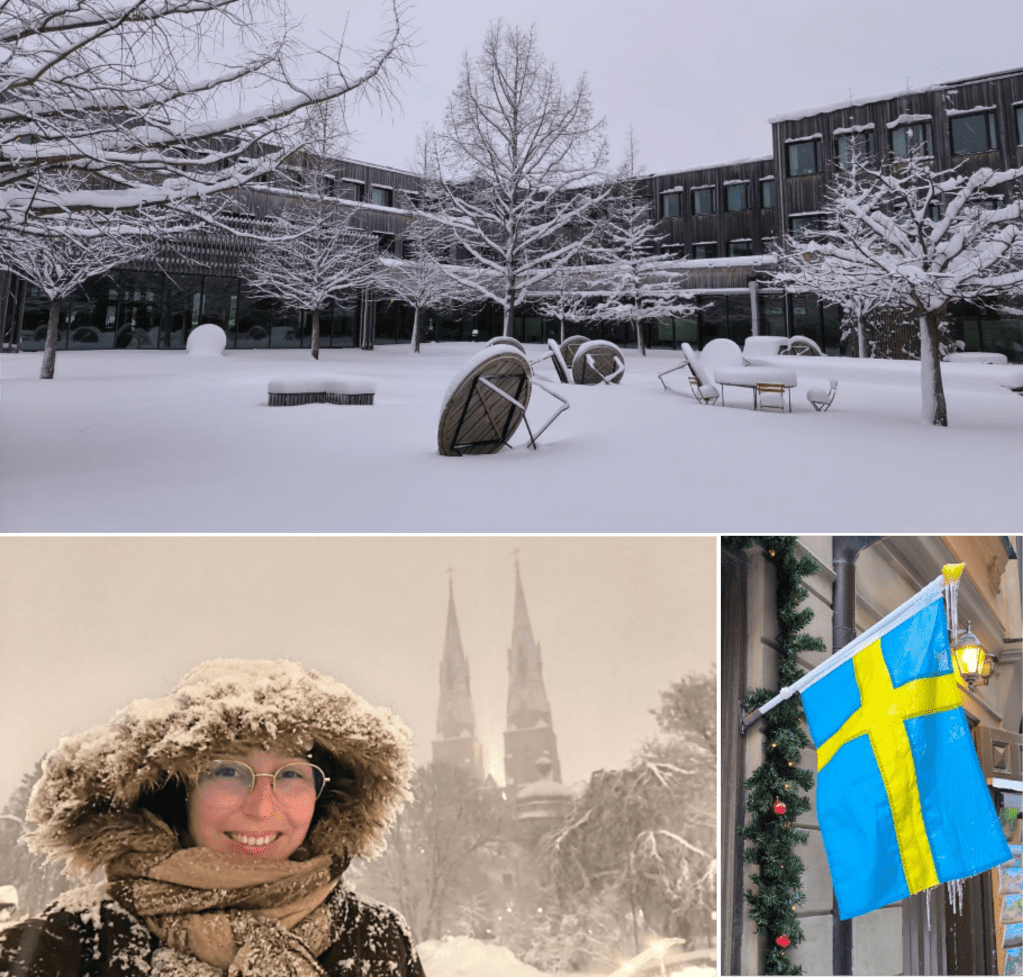
Swedish winter conditions for the workshop: the snowy SLU campus, Sara upon arrival in Uppsala and a Swedish flag with icicles
The in-person workshop, unfortunately, turned into a hybrid meeting due to a snowstorm. Marco and Sara from UPF (Barcelona) were the only ones who made it to the lovely town of Uppsala, north of Stockholm. Nicki and Paidamoyo from UoG (Glasgow) were able to participate online, and participants from Texas joined the video call in the middle of the night, what dedication!
Despite the practical challenges, the workshop turned out quite productive. We spent the two days refining a multi-level theoretical framework on the chain of impacts of aridification events – from environmental factors through natural resource use to human societies and culture. Conceptualising such climatic to socio-ecological impact chains means making our assumptions on causation explicit. This is a crucial starting point for evaluating when, where and how resilience can be enacted – metaphorically breaking the links of the impact chain. A lot of discussion also went into Traditional Ecological Knowledge and practices that lead to resilience, and of course, the palaeoenvironmental and archaeological proxies needed to study past aridification events.
We are looking forward to the promising publications from the SAFAR project and to future meetings, to which we were warmly welcomed. The workshop was not only a great networking platform for us, but also gave us new, exciting theoretical angles for tackling our own research objectives in AGRI-DRY!
Follow AGRI-DRY on LinkedIn and Instagram for all the exciting science coming up!
 AGRI-DRY