Written by Sara Krubeck
After my first short visit to Aarhus University in Denmark last summer, I went back there in March for a full month. My goals for these weeks were to learn a simulation modelling approach called ‘agent-based modelling’ (in short: ABM) and to conceptualise such a model for my specific research project. Thanks to many colleagues at Aarhus University, my research stay turned out very productive and successful. I was kindly hosted by my AGRI-DRY mentor Felix Riede at the Archaeology and Heritage department on Moesgaard campus outside of town. I also regularly visited my AGRI-DRY colleagues Alejandro Ordonez (PI and mentor) and Mudit Joshi (doctoral candidate, or DC) at the Biology department in Aarhus. My mentors furthermore introduced me to several ABM experts in their fields, with whom I discussed my model ideas and questions in detail. All in all, I had many insightful discussions and extended my academic network.
My doctoral project investigates the ‘Resilience of ancient and traditional dryland agriculture’ under climatic fluctuations, and the computational modelling approach complements my otherwise ethnoarchaeological methodology. My model’s objective is to explore how a range of risk management strategies could differently influence crop production under a range of dryland climate scenarios. ABM is increasingly used in various disciplines, including ecology and archaeology, to explore large-scale dynamics resulting from small-scale (‘agent’ or individual) behaviour, especially under alternative scenarios. In my case, the small-scale behaviour to focus on are farming decisions, while the large-scale dynamics are the disturbance response and sustainability of the farm. The scenarios in my model are distinct low rainfall patterns as can be encountered in different dryland areas or that result from climatic changes in one area.
I dedicated my first week of the research stay to ABM literature and tutorials. There are many resources available among which I started with a very helpful tutorial addressed to archaeologists specifically that was developed by colleagues at Aarhus University from the research group ‘Social Resilience Lab’. The tutorial is based on the beginner-friendly programming software NetLogo. Equipped with a better understanding of ABM and model development in general, I then started to formalise my ideas about an agricultural system driven by multiple factors: farming practice investments and climatically variable water availability. During this phase of my work, I met with many researchers at Aarhus University, explaining my ideas and also concerns, and receiving valuable feedback. It was very helpful that everyone I talked to comes from a somewhat different research background, both within the sciences and the humanities. This way, I was confronted with diverse perspectives on all the aspects of my modelling endeavour – that’s the advantage of interdisciplinary collaboration! Many thanks go to my fellow DC Mudit with whom I had long and enriching discussions about climate and crop modelling.
While the model development is an ongoing process, my time in Denmark was a huge leap forward: Beyond my initial goal to conceptualise the model, I already started with the implementation, that is, writing the code. I decided for a model concept that features the actions of one abstract farming household (over time) as opposed to many interacting farmers. As such, my model is not a typical agent-based model, but a closely related type of simulation model. Nevertheless, for visualisation purposes the ABM focused software NetLogo comes in handy. Have a first look at my model’s interface!
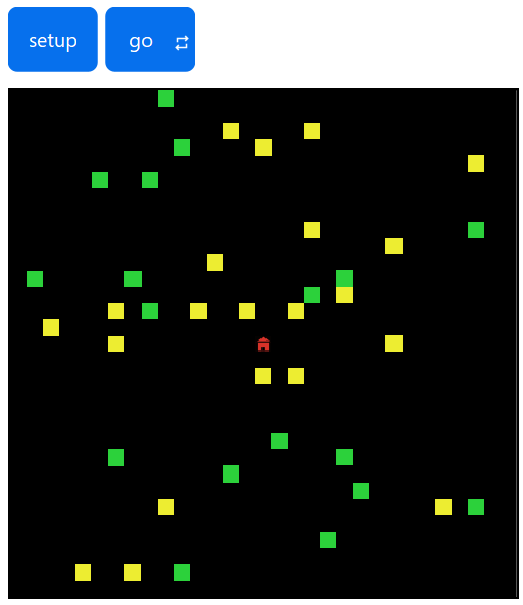
Figure 1. The preliminary interface of my simulation model coded in the programming environment NetLogo.
The next steps in the model development are testing and refining the mechanism. Once my computational model runs smoothly, I can parametrise it in different ways to conduct virtual experiments. Simulation modelling allows us to experiment on a system that is either not directly accessible (for instance, the past) or that we cannot ethically or practically control like in a laboratory (for example, climate change). In order to make the model useful for the contexts studied in AGRI-DRY with a focus on the Mediterranean and Africa over the Holocene up to the present, the parameters and variables should be in accordance with real-world observations: For instance, which farming options are available in terms of crops, water and soil management and what are their socio-economic costs and ecological benefits? Which climatic patterns are typical for different drylands? In order to tackle these kinds of questions, I will consult a range of reference data, from climatic records to traditional ecological knowledge on farming in arid environments. For the latter, I am especially excited about the upcoming ethnographic fieldwork season in Botswana with my fellow AGRI-DRY DCs Thamary Mukuya and Mncedisi Taala. We already conducted a pilot study some months ago that yielded promising first insights!
Apart from the work directly related to my model development, my stay at Aarhus University was also enriched by many inspiring research meetings and presentations to which I was warmly invited. In my free time, I also explored the city and its surroundings. Denmark strikes me as a country that is very rich in visible history and extensive landscapes. Some springtime days during my visit were beautifully sunny – one of our research meetings in Moesgaard literally turned into a nice walk alongside the cattle pastures close to campus. I am looking forward to returning to Aarhus for the AGRI-DRY summer school in just a few weeks!
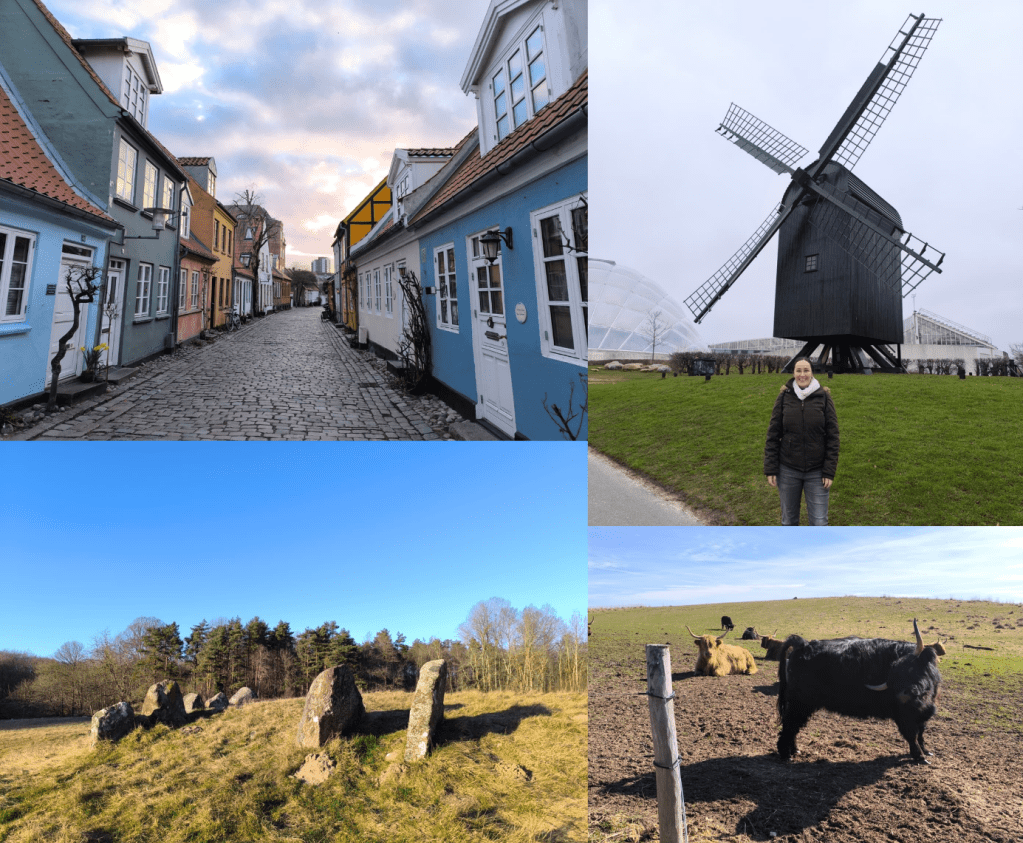
Figure 2. Impressions from Aarhus and surroundings: the picturesque ‘Møllestien’ street in Aarhus, the mill in front of the botanical garden’s greenhouse in Aarhus, the rural landscape close to Moesgaard campus with Prehistoric monuments and a historical cattle breed. Photo credit: Sara Krubeck & Mudit Joshi.
 AGRI-DRY